Building a Balance Sheet
Knowing the financial position of your farm business is critical to its future success. One of the most important financial statements in helping you to understand the financial performance of your operation is the balance sheet.
A balance sheet measures your financial position at a specific point in time providing an overview of the equity position — also known as net worth — of your farm or business, in addition to cash investment. Equity is the owner’s personal investment in the farm or business as measured by the assets owned over the debt owed. A balance sheet showcases equity as current and noncurrent assets less current and noncurrent liabilities, and all are important components of a successful business. Let's dive into the nitty gritty details.
Do I really need to complete an annual balance sheet?
Yes! Most farmers and business owners look at their cash position or year-end profit or loss as a measure of success; however, the cash position isn’t the only measure of business success. Completing a balance sheet allows you to see how your farm business’ equity has changed and grown from year to year by giving credit to adjustments for inventories, assets purchased and the change in liabilities throughout the year. Because a balance sheet shows a snapshot of your operation, it's recommended you prepare a balance sheet as of Dec. 31 each year.
Other benefits of completing a balance sheet each year include:
- Improving your understanding of your business’ financial position, which allows you to make more informed management decisions on your farm for the future based on your equity.
- Lenders, such as Farm Credit, use this information to assess your business. Having a balance sheet completed can expedite loan approval when completed accurately and as of Dec. 31 annually.
- It demonstrates to your lender a greater initiative and interest in how your business performed from year to year.
- Information on the balance sheet can be used to calculate key financial ratios for your farm.
In addition to creating a balance sheet for your farm business, it's also recommended to complete a separate, personal balance sheet on your individual finances.
The Basics of a Balance Sheet
The three main components of a balance sheet are assets, liabilities and owner’s equity. The standard accounting equation represented on a balance sheet is:
Assets = Liabilities + Owner’s Equity
Assets
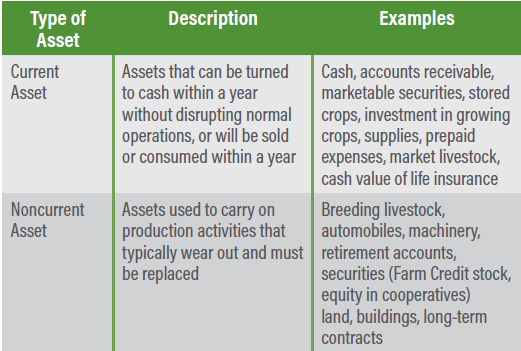
Assets are anything owned by a farm business that has monetary value. Assets are classified as current and noncurrent.
Liabilities
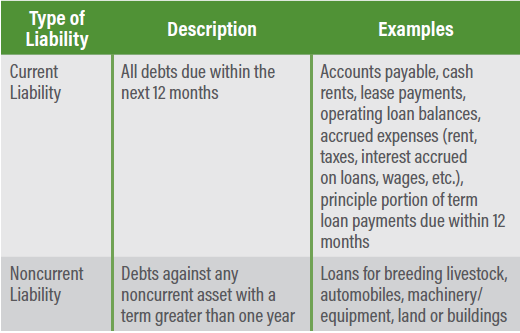
Liabilities are anything owed by the farm business. Like assets, they're classified as current and noncurrent.
Owner’s Equity
Owner’s Equity is the area of the balance sheet that will need to be calculated since it is dependent on the value of your assets and liabilities. It shows what your business is worth as of the date of the balance sheet.
To calculate Owner’s Equity, subtract liabilities from your assets. The remaining value is Owner’s Equity.
Assets – Liabilities = Owner’s Equity
As a young and/or beginning farmer, it often feels as though progress moves slowly and business growth — and ultimately success — is not easily measured. Completing an annual balance sheet allows you to track the financial success of your business as net worth grows over time. Understanding the change in net worth is key. Is net worth increasing or decreasing? Why is it changing?
The goal is for net worth to increase each year because of the earnings generated by the farm business, not simply because assets were valued at a higher level. Take some time to fill out a balance sheet and compare it to one completed on Dec. 31. Do this task for three years and then reference the first balance sheet you completed to see how far your business has come.
Want to see it explained a little easier? Check out this quick video! If you’re ready to try your hand at your own balance sheet, click here to download our balance sheet case study.
This content is provided for informational purposes only and is not intended to serve as investment, tax, accounting or legal advice, nor as a substitute for the advice of qualified professionals.
The information presented reflects assumptions, source materials and conditions as of the time of preparation and may be incomplete, inaccurate or subject to change. Horizon Farm Credit does not endorse and is not responsible for the accuracy of information provided by third‑party sources referenced in this content.
Nothing presented here constitutes, or should be construed as, a commitment to lend or to provide any financial product or service. In no event shall Horizon Farm Credit be liable for any actions taken or decisions made in reliance upon, or use of, the information contained in this content
Recommended By AgBizInfo



Serves over 22,000 members throughout Delaware, Maryland, Pennsylvania, Virginia and West Virginia with loans for farming, land, home and refinancing, as well as crop insurance.